
Adapted by John Le and tested by Radar.
INTRODUCING ANE MÆRSK
The ANE MÆRSK is the first of her kind – the first large container vessel able to run on low-emissions fuel like bio- and e-methanol. Since ANE MÆRSK first hit the waters in January 2024, many more dual-fuel vessels have set sail, marking a new and important chapter in the decarbonization of shipping and global trade. ANE MÆRSK is 1,148.2 ft. (350 meters) long and 175.5 ft. (53.5 meters) wide. When empty, the vessel weighs 52,580.25 tons (47,700 tonnes) and fully loaded with cargo, fuel and crew, the vessel can transport an astonishing 209,439.1 tons (190,000 tonnes), which is the same as 29,000 African elephants. The vessel can load 16,592 TEU (twenty-foot equivalent) containers, and if you line them all up, the line would be 62.4 miles (100.5 km) long, corresponding to 959 football pitches.
NAVIGATING CHANGE – THE HISTORY OF SHIPPING
Human beings have been transporting goods by sea for over 5,000 years, but until the Industrial Revolution and the invention of the steam engine, we were reliant on the weather. No wind, no crossing. With the introduction of steam power, the crew of a ship was no longer dependent on weather or manual propulsion for the first time in human history. The invention completely revolutionized maritime transport, making new routes possible and giving trade by sea a major boost. Although steam engines were a vast improvement on sail, they were still inefficient, and it would not be long before maritime transport was once again transformed by the invention of the diesel engine. However, revolutions in shipping take time, and it would be several decades before diesel fully replaced steam power. Maersk purchased its first diesel-powered vessel, the LEISE MÆRSK, in 1921, just nine years after the launch of the first ever diesel-powered ocean-going merchant vessel. In 1956, the industry transformed yet again, when the efficiency of ‘containerized cargo’ was introduced, by loading truck trailers directly on-board vessels. The introduction of the container reduced the time it took to load and unload vessels from several days to a matter of hours. Thanks to the container and the barcode – the hidden enablers of world trade – a manufacturer in any part of the world can sell its goods in all markets, making globalization physically possible. The world as we know it today is deeply reliant on global supply chains. From the banana farmer in Colombia, to the Danish child peeling a banana for their lunch, supply chains keep the world connected and ensure the flow of foods, medicine, goods and materials to people all over the world.
WHAT’S IN A NAME
Since 1906, all vessels in the Maersk fleet have had the MÆRSK name as part of their name. Most of the early vessels had first names related to the founding family, but as the fleet grew and outnumbered the family names available, the naming tradition had to be adjusted. Today you will also see Maersk vessels named after, for instance, cities and rivers. When deciding how to name the new series of dual-fuel vessels, Maersk returned to the tradition of naming vessels after members of the founding family – this time starting with the letter A to signal a new era. ANE MÆRSK is named after Ane Mærsk Mc-Kinney Uggla, the chair of A.P. Moller Holding, which is the parent company of A.P. Moller – Maersk. A.P. Moller – Maersk was founded in 1904 by Arnold Peter Møller. Ane is the granddaughter of the Group’s founder Arnold Peter Møller and his wife Chastine Mc-Kinney Møller.
THE WHITE STAR – A BEACON OF HOPE
The iconic white, seven-pointed star has been part of Maersk’s heritage since before the company was founded in 1904 and is an enduring symbol of the strong family bonds that still run through the heart of the company over 100 years later. Early in his career, Captain Peter Mærsk Møller, the father of A.P. Møller, worked for an English shipowner, and his wife, Anna, would sometimes accompany him on voyages. It was on one of these voyages that Anna became gravely ill. Fearing that she wouldn’t make it, Peter Mærsk Møller went up on deck and prayed to God for a sign that his wife would recover. It was then that he saw a single star lighting up the otherwise gray sky. Anna did recover, and in 1886, when Peter Mærsk Møller purchased his first steamship – the steamship LAURA – he adorned the funnel of the ship with a white seven-pointed star on a pale blue background, as a tribute to his beloved wife. For Peter Mærsk Møller, the star came to signify her recovery and their good fortune. Since then, the white seven-pointed star on its emblematic sky-blue background has been synonymous with Maersk, but the logo itself has been through some evolution over the years. There have been many versions of the logo, but the Maersk logo of today dates to the beginning of the 1970s, when it was decided that a more modern approach was needed.
IMPROVING LIFE FOR ALL BY INTEGRATING THE WORLD
As a global leader in logistics services, Maersk has 100,000+ customers, operates in almost 130 countries and employs more than 100,000 people. From humble beginnings as a steamship company to becoming an integrated logistics company working to connect and simplify its customers’ supply chains, Maersk deploys 700+ vessels and transports almost 20%of the world’s food, materials and goods.
ALL THE WAY TO ZERO – A COMMITMENT TO A DECARBONIZED FUTURE
As the world grapples with climate emergencies, the future of supply chains and global trade rests on the ability to innovate and promote new energy sources. Maersk has taken on a serious obligation to reach net zero greenhouse gas emissions by 2040 across the entire business. While decarbonizing its own operations, Maersk has also made a social pledge to lead the way in addressing the climate crisis by decarbonizing global supply chains and enabling a just transition to a net-zero economy.
Maersk has set ambitious targets on the road to 2040 to ensure significant progress in this decade: across the ocean, land, air and our terminals. And with the order and delivery of many dual-fuel vessels, able to sail on low emissions fuel such as bio- and e-methanol as well as biomethane, so far the mission to decarbonize the fleet is well underway.
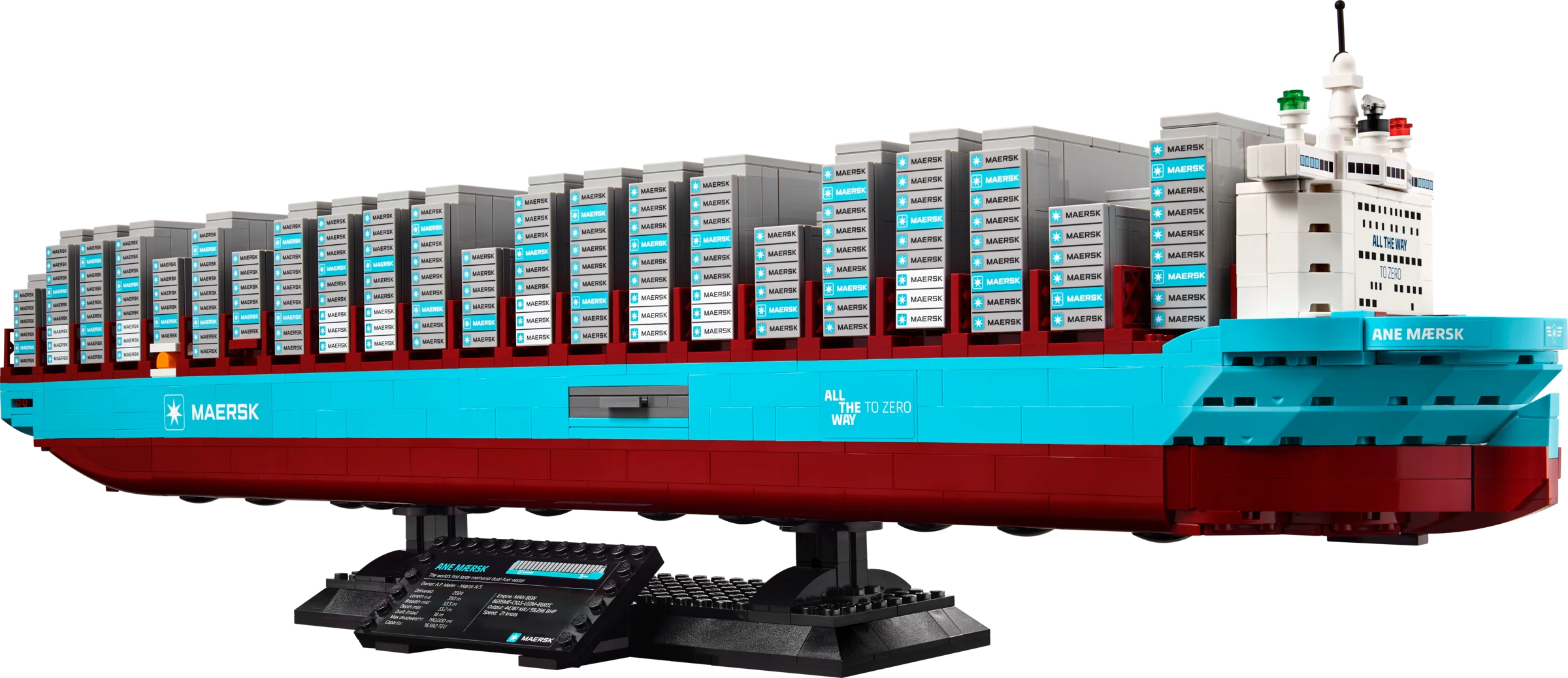
Start or expand a collection with this detailed Maersk Dual-Fuel Container Vessel (40955) LEGO® collectible toy building set, for adults or teens ages 12 and up. Packed with details and functions, the container ship model kit has an opening bridge section with crew quarters and transparent engine-room windows. There are slide-out gangways on each side, buildable containers, a name plate for the display base and much more. The set also has printed elements and stickers. The set contains 1,516 pieces.
CONTAINER SHIP MODEL BUILDING KIT – Engage a ship-lover’s passion with this Maersk Dual-Fuel Container Vessel (40955) LEGO® set, a detailed creative decor project for play or display.
FIRST OF HER KIND – The brick-built replica of the ANE MÆRSK container ship encourages builders to bring the first-ever low-emissions, dual-fuel vessel to life in a more house-friendly size.
LEGO® CARGO SHIP TOY – This model includes distinct details such as a removable plate to explore the crew quarters, transparent engine-room windows, slide-out gangways, information plaque and more.
COLLECTORS’ DISPLAY PIECE – This toy building set offers teens and adults the opportunity to share their passion and admiration for this trailblazing, seagoing vessel as they assemble the model.
DIMENSIONS – The collectible 1,516-piece brick-built ANE MÆRSK container ship model, on its stand, measures over 7 in. (18 cm) high, 23.5 in. (60 cm) long and 4.5 in. (12 cm) wide.